TRANSMISSION // 2610.40589v1 AI ADAPTED
AI agents test quantum-spin predictions and flag a drifting signal
In an arXiv preprint, researchers report that collaborating AI agents derived and tested predictions about quantum spins in diamond, revising an experiment after detecting signal drift.
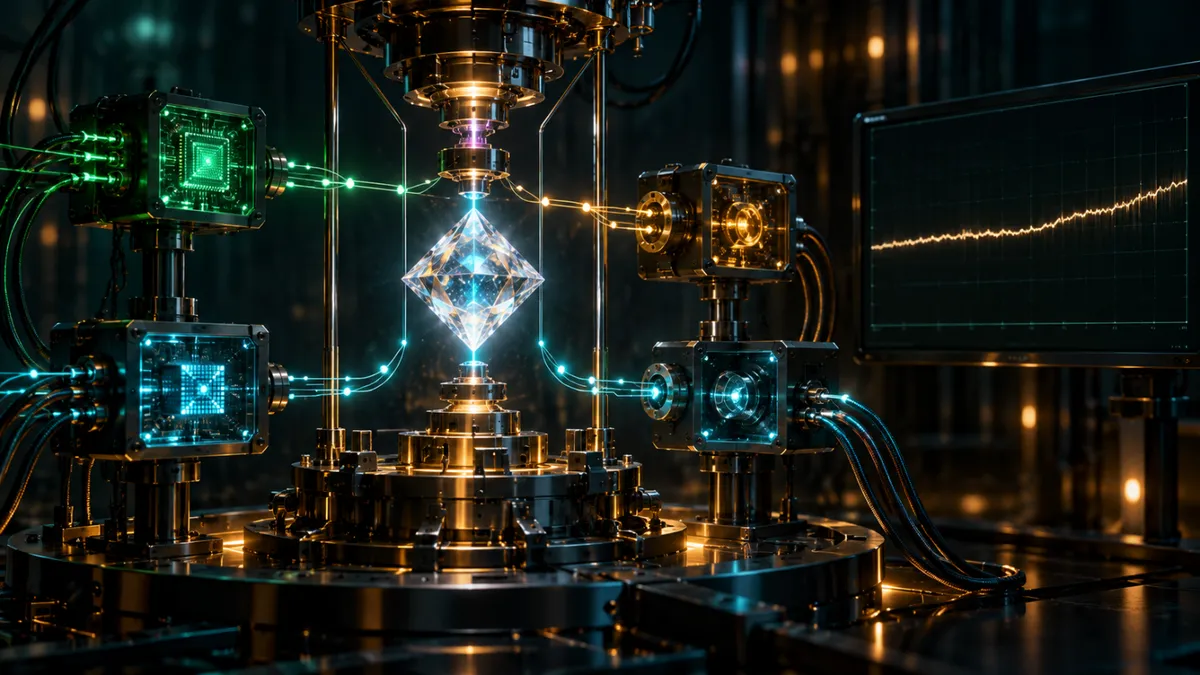
A proposed autonomous laboratory used large-language-model agents to check one another’s work while investigating how ensembles of quantum spins in diamond respond to microwave pulses.
What the study found
Mansouri and colleagues report in an arXiv preprint that their AI agents could generate or reject research questions, request separate theoretical checks, and stop or redirect investigations. In a demonstration involving quantum spins in diamond, the agents derived the minimum number of calibration settings needed to predict responses to a defined family of microwave pulse sequences. They checked the result computationally and designed experiments to distinguish competing predictions.
An initial experiment agreed with the theoretical predictions, but repeated reference measurements revealed that the signal was drifting during data collection. The agents treated the result as inconclusive and revised the measurement protocol without relaxing the acceptance criteria. According to the authors, the revised experiment met those criteria and supported the predictions.
Why it matters
The demonstration illustrates a possible way to address a known concern about AI-assisted research: conclusions can go beyond what the evidence supports. Here, the reported system did more than seek agreement with a prediction; it also used checks that led the agents to withhold a conclusion from the first experiment.
Limits and unknowns
The findings concern one demonstration and a defined family of pulse sequences. The abstract does not state the derived number of calibration settings, the acceptance criteria, the details of the revised protocol, or the magnitude of the signal drift. It also does not establish how reliably the approach would work across other experiments or research fields. The work is a preprint, and this account is based on its abstract.
- artificial intelligence
- autonomous research
- quantum spins
- diamond
- experimental physics
- preprint