TRANSMISSION // 2610.40565v1 AI ADAPTED
AI coding agents build a robotics simulation benchmark
An arXiv preprint introduces agent-built robotics simulations and reports that leading models failed all test tasks, though several learning approaches improved performance.
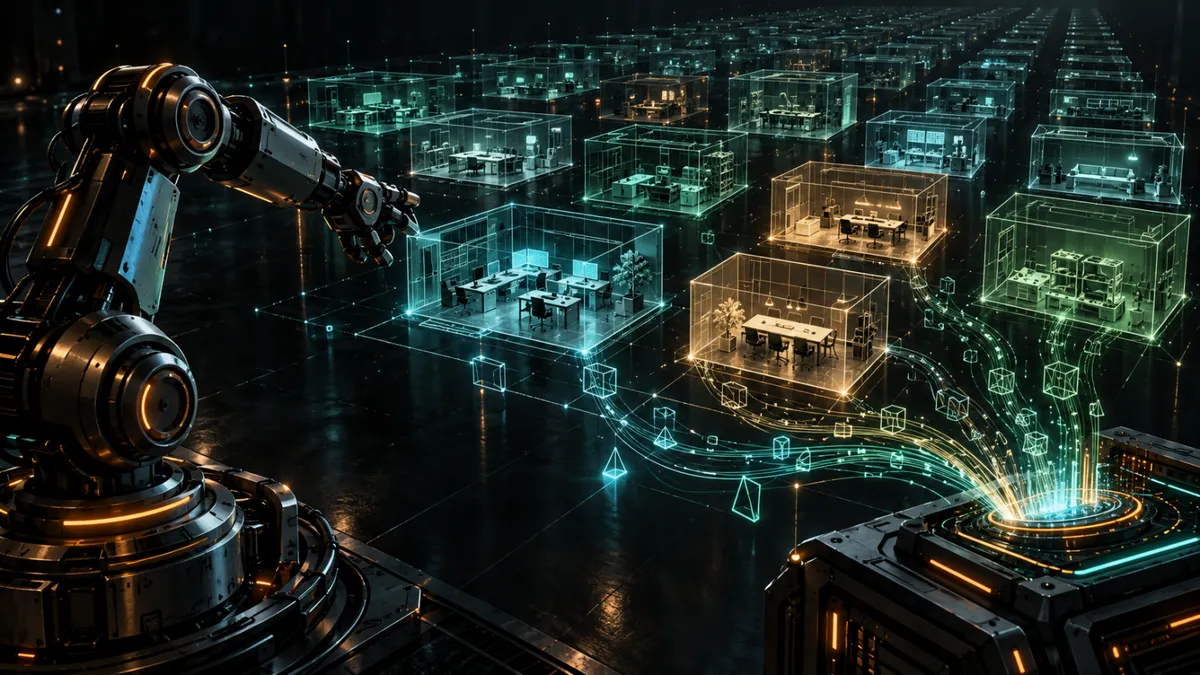
Creating robotics simulations demands expert work. Pranjal Aggarwal and Sean Welleck propose using coding agents to build and audit simulations, then use the resulting environments to test AI models.
What the study found
In their arXiv preprint, the authors introduce Gym-Anything for Robotics, a framework in which coding agents create simulations. They say they selected simulations using U.S. GDP data to cover economically valuable physical work, and used an adversarial creation-and-audit loop to check simulations and tasks against defined criteria.
The resulting RoboWorld collection contains 25 simulations, with 175 training and 25 test reinforcement-learning environments of varying difficulty. The authors report that even the best frontier models failed every test task, with an average reward of 0.06.
They also report substantial performance improvements from several approaches: learning in context over repeated attempts; a teacher with access to simulator state instructing a student; learning from a model’s own privileged experience; and using code policies to generate demonstrations for training vision-language-action models.
Why it matters
Broader simulations could offer more ways to train and evaluate embodied AI without requiring experts to handcraft every environment. RoboWorld also provides a test of the gap between current models and the simulated tasks its authors selected. Whether skills learned in these environments transfer to physical robots remains an open question.
Limits and unknowns
The abstract does not specify the individual tasks, audit criteria, models tested, reward scale or numerical gains from each improvement method. It also does not describe real-world robot experiments or establish how faithfully the simulations reproduce physical conditions. The reported results are preprint findings, and their interpretation depends on details beyond the abstract.
- robotics
- simulation
- coding agents
- reinforcement learning
- embodied AI
- benchmark