TRANSMISSION // 2026.10.29.762774v1 AI ADAPTED
Blueberry flower buds lose a local ice barrier as spring arrives
A bioRxiv preprint reports that developing blueberry flowers remain ice-free in fall and winter even as surrounding bud tissues freeze, but lose that protection in spring as their water-conducting connections mature.
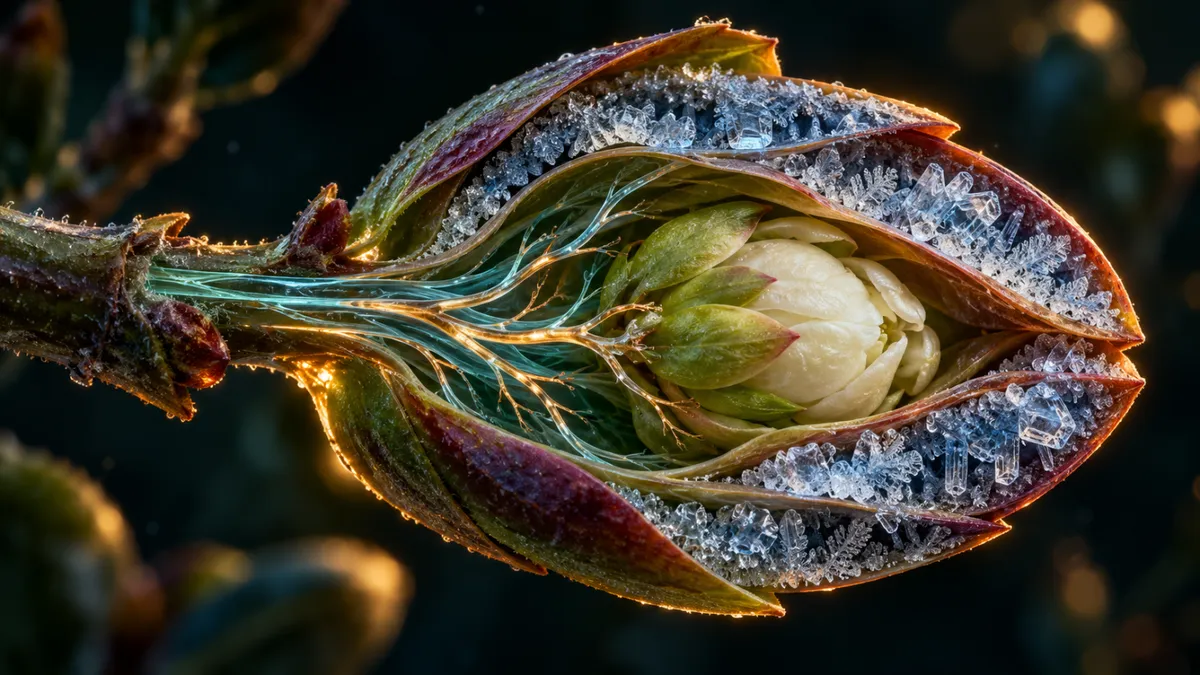
Highbush blueberry buds can withstand winter freezing while protecting their developing flowers. A new preprint locates that protection at the individual flower primordium and links its seasonal loss to changes in nearby xylem.
What the study found
Villouta and colleagues examined highbush blueberry buds collected in fall, winter and spring, combining freezing tests with thermal analysis, cryomicroscopy and examination of water content and xylem anatomy. In their bioRxiv preprint, they report that ice formed in the stem, reached the bud within minutes and accumulated in its scales. The bud axis froze in every season, but the flower primordia—the structures that develop into flowers—remained ice-free in fall and winter and froze in spring. The authors therefore locate the barrier at each primordium rather than at the bud base.
Whole-bud LT50, a measure of freezing tolerance, was −20°C in fall, −31°C in winter and −16°C in spring. Water content increased only in spring.
Why it matters
A continuous xylem trace, a water-conducting connection, reached every primordium in every season. Its structure changed by spring, when more mature-looking xylem elements predominated. The authors propose that the trace’s immature state contributes to the winter ice barrier. This could help explain how developing flowers avoid internal ice despite being connected to the stem.
Limits and unknowns
The seasonal coincidence does not establish that xylem maturation causes the barrier to disappear; its physical mechanism remains unresolved. The abstract does not give sample sizes, growing conditions or detailed experimental procedures, limiting assessment of how broadly the findings apply. The work is a preprint, not an established consensus.
- highbush blueberry
- flower buds
- freezing tolerance
- ice barrier
- xylem
- seasonal development