TRANSMISSION // 2026.10.29.759696v1 AI ADAPTED
Two mitochondrial genome configurations found in a model green alga
A bioRxiv preprint reports two mitochondrial DNA configurations in Chlamydomonas reinhardtii and proposes a model for how the genome might replicate.
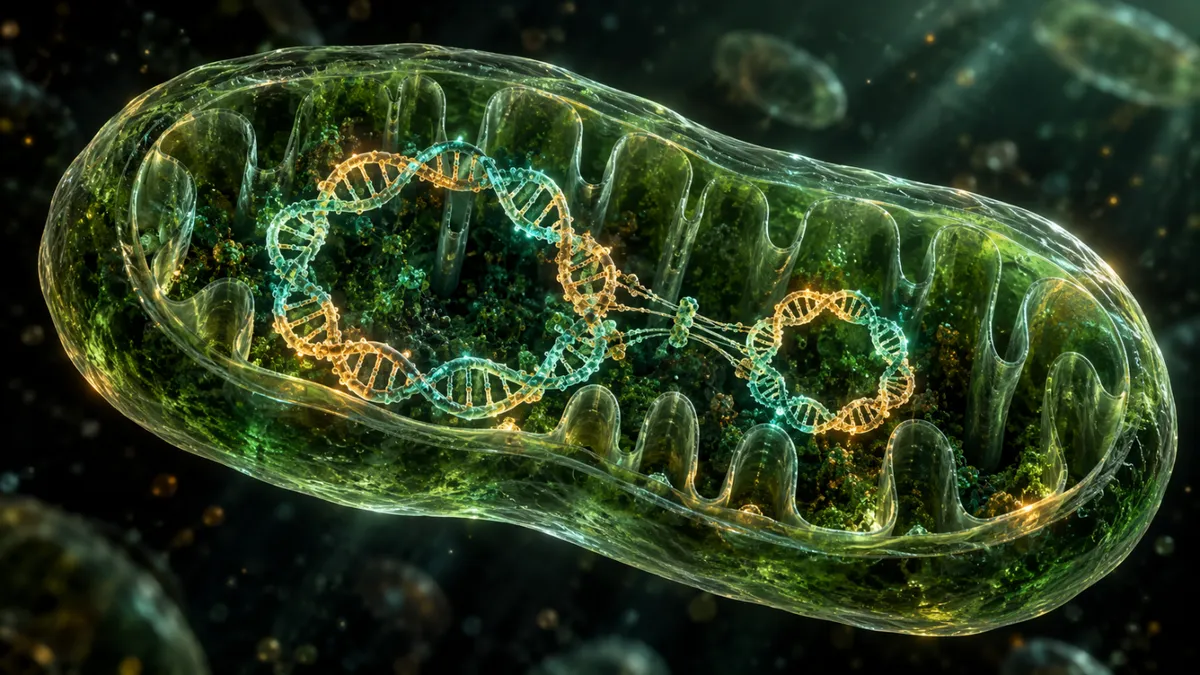
The mitochondrial genome of a widely studied green alga may be more structurally complex than its longstanding textbook description suggests, according to a new preprint.
What the study found
He and colleagues used high-accuracy long-read sequencing to examine mitochondrial DNA in Chlamydomonas reinhardtii. In their bioRxiv preprint, they report two coexisting genome configurations: the previously described 15.8-kilobase version and an expanded 19-kilobase version. The latter has terminal inverted repeats that duplicate two genes, cob and nad4.
The authors report no evidence for the conventional telomeric structures previously described at the ends of the genome. Their single-molecule analysis also identified linked, multimeric DNA structures joined by a conserved 17-base sequence. Digital PCR measurements showed substantial differences in the relative abundance of the two configurations across the CC-5325 lineage and additional field-isolated strains.
Why it matters
The findings challenge the longstanding description of the alga’s mitochondrial genome as a single linear molecule capped by inverted telomeres. The authors propose that its structural features support a recombination-dependent replication model, potentially explaining how mitochondrial DNA could replicate without conventional telomeres or reverse transcriptase-like genes.
They also identified mitochondrial DNA segments in the nuclear genome. These segments can complicate amplification and measurement of mitochondrial configurations, making them important to distinguish in future analyses.
Limits and unknowns
The replication mechanism is a model supported by the reported structural features, not a demonstrated process. Finding no evidence for canonical telomeres is not proof that every possible telomeric structure is absent. The abstract does not provide sample sizes, detailed measurement results or information about the functional consequences of the configurations. The study is a preprint and has not been established here as peer reviewed.
- Chlamydomonas reinhardtii
- mitochondrial DNA
- heteroplasmy
- long-read sequencing
- genome replication
- NUMTs